Yes, you can obtain a divorce in California without your spouse's signature through a legal process called a default divorce. When one spouse refuses to cooperate, disappears, or simply won't sign divorce papers, California law provides a clear path forward.
With over 14 years of experience as a Sacramento divorce lawyer, I've guided countless clients through the default divorce process when their spouse refused to participate. This article explains exactly how you can move forward with your divorce in Sacramento County, even without cooperation.
Can You Get a Divorce If Your Spouse Won't Sign the Papers?
Yes, you can divorce in California without your spouse's signature. California is a no-fault divorce state, meaning one spouse's refusal cannot prevent divorce. The law recognizes your right to end the marriage unilaterally.
One spouse's refusal to sign divorce papers simply triggers what's called a "default divorce" scenario. The process takes longer than an uncontested divorce where both parties cooperate, but it achieves the same legal result. Your spouse's cooperation is preferred for efficiency, but not mandatory for finality.
Refusing to sign only delays the divorce proceedings; it doesn't stop them. A default divorce requires strict procedural compliance and typically takes 7-12 months from filing to final judgment. While this path gives you control over the terms within legal limits, it also creates unique vulnerabilities if not executed with technical precision.
What Is a Default Divorce in California?

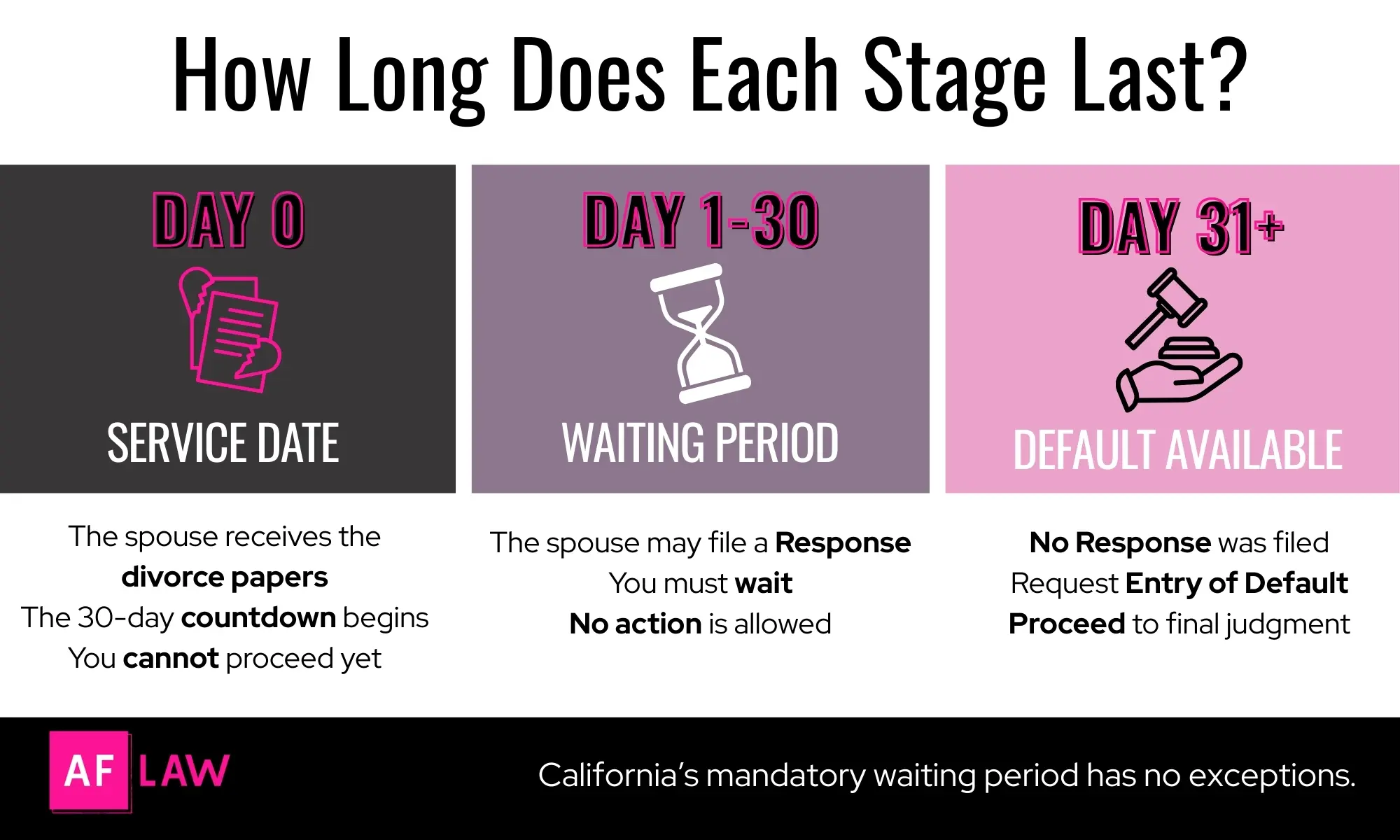
After you file and serve divorce papers, your spouse has 30 days to file a Response (Form FL-120) with the court. If they don't respond within this window, you can request entry of default with the court clerk. This formally notes their non-participation and allows you to proceed to the final judgment without their involvement.
True Default vs. Default with Agreement
True Default means no response and no signed Agreement. The court decides based solely on what you requested in your Petition. Default with Agreement means your spouse doesn't file a Response (FL-120) but does sign a divorce settlement addressing property division, child custody, and support. The latter offers more flexibility in terms, but it still requires their signature on the agreement itself and the defaulting party to complete their financial disclosures1.
Important note: The vast majority of divorces resolve as "uncontested," which includes both types of defaults. It is common to finalize divorces through administrative processes rather than trials.
How Does the Default Divorce Process Work in Sacramento?
The divorce process involves specific steps with strict deadlines and procedural requirements. Sacramento County follows California's statewide default procedures established by the California courts.
Step 1: File and Serve Your Divorce Petition
You begin by filing the Petition for Dissolution (FL-100) and Summons with Sacramento County Superior Court. Proper service requirements mandate that a third party, not you, personally serve your spouse with these court documents.
You must then file the Proof of Service (FL-115) with the court to document when and how service occurred. Improper service can invalidate everything that follows, making this step critical to your entire divorce case.
Step 2: Wait for the 30-Day Response Period
Your spouse has exactly 30 calendar days from the date of service to file a Response with the court. You cannot take any legal action during this window. If your spouse files a Response, the case becomes a contested divorce and follows a different path with negotiations or court hearings.
Step 3: Request Entry of Default
On day 31 or later, if no Response was filed, you submit a Request to Enter Default (FL-165) to the court clerk. The clerk enters the default and mails notice to your spouse at their last known address. This formally documents their non-participation in the divorce proceedings.
Step 4: Complete Financial Disclosures
You must serve your spouse with complete financial information, including income, expenses, assets, and debts, through the Preliminary Declaration of Disclosure. You then file proof of service with Declaration Regarding Service (FL-141). According to California self-help court resources, this requirement cannot be waived in a True Default. The court will not process your final judgment without this filing.
Important note: This protects your non-participating spouse from financial fraud. Any misstatements on these financial disclosures can be grounds to set aside your judgment later.
Step 5: Submit Final Judgment Package
You prepare the final paperwork, including the Declaration for Default (FL-170) and Judgment (FL-180). These court documents tell the judge what orders you're requesting for property division, child custody, child support, and spousal support.
The judge reviews your package administratively. Most default cases don't require a court appearance. After approval, you receive a Notice of Entry of Judgment (FL-190) confirming your divorce is final.
The entire divorce process requires monitoring at every step. One procedural error can delay your divorce case or make your default judgment vulnerable to challenge. That’s why the assistance of our unmatched legal team can mean the difference between securing an ironclad divorce and facing future difficulties.
How Long Does a Default Divorce Take in California?
California law mandates a minimum six-month waiting period from the date your spouse was served, and this timeline cannot be shortened for any reason. Setting realistic expectations about timing is crucial.
- Uncontested with cooperation: 6-8 months. When both spouses cooperate and sign agreements, the process moves quickly after the mandatory waiting period.
- True default (no response): 7-12 months. The 30-day response window plus administrative court processing adds time beyond the six-month minimum.
- Default with complications: 12-18 months. Complex property division, child custody disputes, or procedural mistakes requiring refiling extend the timeline significantly.
Several factors may impact the timeline of a default divorce, including:
- Sacramento County court processing speed
- Complexity of community property and debts
- Whether you need a default hearing for testimony
- Procedural mistakes requiring refiling or corrections
The mandatory six-month waiting period applies to everyone in California. The administrative steps typically add one to six additional months, depending on case complexity and court scheduling.
What Happens If My Spouse Can't Be Found or Served?

Your spouse may have disappeared or be actively avoiding service. California law provides alternative service methods specifically for this situation when personal service isn't possible.
#spoilers_start
Service by Publication
After proving diligent search efforts through documented attempts to locate your spouse, you can petition the court for permission to serve by publication. This involves publishing a legal notice in a newspaper in the area where your spouse was last known to reside. Service by publication requires court approval and adds both time and additional costs to the process.
Service by Posting
This method involves posting notice at the courthouse and mailing copies to your spouse's last known address. Service by posting is used when publication isn't feasible. Like publication, it requires court permission and proof that you attempted personal service first through a process server.
Service by Mail (with Court Permission)
In limited circumstances, the court may allow service by mail to your spouse’s last known address. This requires showing that your spouse is evading service or cannot be located despite reasonable efforts documented in a declaration.
#spoilers_end
Alternative service methods are legally valid but require additional steps and court approval. They typically extend your timeline by two to four months beyond standard divorce proceedings.
How Much Does a Default Divorce Cost in Sacramento?
The actual costs involved in pursuing a default divorce vary significantly. Costs depend on whether you hire a divorce attorney or not and the complexity of your divorce case.
Court Costs (everyone pays these):
- Filing fee: $435-$450 in Sacramento County for filing the divorce petition.
- Service of process: $40-$100 for personal service by a process server.
- Service by publication (if needed): $1,200-$2,400 for newspaper publication and mailings.
- Additional copies and certified documents: $25-$75 for official court copies.
Attorney Costs (if represented):
- Hourly rates: Sacramento divorce attorneys charge $275-$600/hour.
- Default divorce with attorney: Typically $2,500-$5,000 for straightforward default cases.
- Complex defaults: $5,000-$15,000+ for contested issues like property division or custody disputes.
DIY Costs:
- Self-represented option: Complete default divorce for court costs only.
- Sacramento County resources: Free self-help resources and facilitator services available.
- Fee waivers: Available for low-income filers through Form FW-001.
Important note: According to California court statistics, 80% of people finalizing divorce judgments are self-represented at least in part, largely due to attorney cost concerns. However, procedural mistakes in default cases can be expensive to fix later.
You should budget for court costs at a minimum. Attorney representation costs more up front, but it reduces the risk of costly procedural errors that could invalidate your default judgment.
What Are the Risks of Default Divorce?
While a default divorce successfully ends the marriage, the judgment faces unique legal vulnerabilities. Understanding these risks is crucial before proceeding with a default judgment.
The CCP § 580 Relief Limitation
California Code of Civil Procedure Section 580 prohibits the court from granting any relief that exceeds what you specifically requested in your original Petition.
If you forgot to list a specific asset, debt, or request for spousal support in your initial paperwork, the court cannot award it in the final judgment. Any order that violates this rule is void and can be challenged years later. This makes the initial petition critically important in default cases where your spouse won't be negotiating terms.
Grounds for Setting Aside the Judgment
Your spouse can later challenge the default judgment through various legal grounds. These include improper service of the divorce petition, fraud or perjury on financial disclosures, lack of actual notice, or excusable neglect. Some grounds have time limits ranging from six months to two years, while jurisdictional defects can be challenged indefinitely.
Common grounds for set-aside:
- Improper service: If the service was defective or not properly documented, the court never had jurisdiction over your spouse, and the judgment is void regardless of the time passed.
- Fraud on financial disclosures: Lying about assets, income, or debts on mandatory disclosure forms is grounds for a set-aside within one year of discovery under California Family Code Section 2122.
- CCP § 580 violation: Any relief granted beyond what you specifically requested in your Petition makes that portion of the judgment void and subject to challenge at any time.
Default judgments require absolute procedural precision. One mistake can create legal vulnerability that lasts years after your divorce is "final."
Contested vs. Uncontested Divorce — What's the Difference?
The terminology often confuses people going through a divorce. Default divorce falls under "uncontested," but that doesn't mean your spouse agreed to the terms.
Default divorce is "uncontested" only in the technical sense that your spouse didn't file paperwork. It's not the same as an amicable divorce with signed agreements.
What Happens to Property, Custody, and Support in Default Divorce?
When your spouse doesn't participate, the court makes decisions based solely on what you request and California law. Your non-participating spouse loses the right to negotiate, but doesn't automatically lose all legal rights.
Property Division
- Community property rules apply: California law requires 50/50 division of assets and debts acquired during marriage unless there's an agreement otherwise.
- List everything in your Petition: You must detail every asset and debt in your Petition or Property Declaration (FL-160) for the court to divide it.
- Court awards only what you listed: The judge will generally award you what you request, but only assets and debts you specifically identified in your initial paperwork.
- No automatic windfall: Your spouse's lack of participation doesn't mean you automatically get everything; it means they can't argue for a different division than what you proposed.
Child Custody and Support
- Best interests standard applies: The court always prioritizes children's best interests, regardless of whether both parents participate in the court case or not.
- Propose a custody arrangement: You'll need to propose legal custody and physical custody arrangements, but the judge evaluates them independently based on California law.
- Guideline calculator determines support: Child support follows California's statutory calculator based on incomes and timeshare percentages, not your spouse's refusal to participate.
- Parental rights remain: Your spouse's non-participation doesn't eliminate their child support obligation or parental rights; the court makes orders based on available financial information.
Spousal Support (Alimony)
- Must request in Petition: If you're requesting spousal support, you must specifically ask for it in your Petition with a proposed amount and duration, or you waive this right.
- Court evaluates independently: The judge evaluates your request based on California Family Code Section 4320 factors, including marriage length, standard of living, and each party's earning capacity.
- Long-term marriage jurisdiction: For marriages over 10 years, the court usually retains jurisdiction indefinitely unless you request a specific termination date in your Petition.
Important note: Your spouse's failure to respond means they can't contest your support request, but the judge still reviews it for reasonableness. Extreme or unsupported requests may prompt the court to schedule a default hearing for testimony.
Default divorce doesn't give you unlimited power to dictate terms. The court ensures orders are fair, legal, and protect any children involved, even without your spouse's input.
Take Control of Your Sacramento Default Divorce Today
As a Sacramento family law firm serving clients throughout Sacramento, Yolo, and Placer counties, AF Law has guided hundreds of clients through successful default divorces. We ensure every form is filed correctly, every deadline is met, and your Petition requests everything you're entitled to under California law.
Contact us today to schedule your consultation and take the first strategic step toward your future.

%205.avif)