Splitting assets 50/50 sounds simple, until you have to trace bank deposits from 2015 or calculate who owns what percentage of your house. One financial misstep during your marriage can cost you thousands in legal fees trying to prove what's yours.
With over 14 years as a Sacramento property division lawyer, I've seen how California's community property laws turn straightforward divorces into complex financial battles. I’ll break down what community property actually means, how courts divide assets, and what you need to protect during divorce.
How Community Property Works in California

California operates as one of nine community property states in the U.S. In these states, the law presumes that anything acquired during marriage belongs equally to both spouses. This applies whether you earn $50,000 or $500,000 annually. Generally, the income, assets, and debts you and your spouse accumulate during the marriage belong to both of you equally.
The Three Types of Property Classification
California law categorizes marital assets into three distinct types.
Community Property
Most assets and income acquired while married spouses reside in California are community property. For example, if a spouse purchases an SUV with income they earned during the marriage, the vehicle will belong to both spouses equally, regardless of whose name appears on the title.
Separate Property
Assets each spouse owned before marriage, received as gifts, or inherited during marriage may be separate property. Property acquired after the date of separation and before the divorce also remains separate. These assets stay with the original owner during divorce.
Quasi-Community Property
Quasi-community property can include assets acquired while living in another state that would have been community property if you lived in California at the time. Courts treat these like community property during California divorce proceedings.
California's 50/50 Division Rule
Some states require divorcing spouses to divide their assets fairly and equitably, although not necessarily equally. In contrast, California mandates an exact 50/50 split of community property. This means that divorce litigation tends to focus on the value and characterization of assets rather than the fairness of the split.
How the Equal Division Rule Impacts Your Divorce
The heavy financial consequences of California’s 50/50 rule can drive up costs. California is one of the most expensive states to get divorced in, with average costs ranging from $12,000 to $26,000 per spouse. Cases that require litigation can cost over $100,000.
The state’s equal division rule dictates legal strategy. Attorneys must prove the origins of assets through bank statements, purchase records, and other documentation. The services of forensic accountants and business valuators may be required, which further increases costs.
Common Assets Subject to Community Property Laws
Community property in California includes most assets acquired during marriage, from checking accounts to real estate to lottery winnings. Generally, if one spouse earned it, bought it, or accumulated it while married and living in California, both spouses own it equally.
Bank Accounts and Financial Assets
Joint bank accounts funded with marital earnings are community property. Even accounts titled in one spouse's name become community property if that spouse deposits income they earn during the marriage. Investment accounts, stocks, and bonds purchased with marital funds follow the same rule.
When separate and shared money mix in the same account, the court presumes that marital expenses were paid with community funds. This presumption makes proving separate property claims significantly harder without meticulous records.
Real Estate and Property Division

For many spouses, the family home is the largest marital asset. In most cases, a home purchased during the marriage is considered community property requiring equal division.
Real estate that is acquired before marriage but paid down with marital earnings is a bit more complicated. It becomes a “mixed-character asset”.
California courts apply a specific formula to calculate separate and community interests in mixed-character assets. This formula, called the “Moore/Marsden calculation,” accounts for the following:
- The amount one spouse paid separately before marriage
- The amount paid down during marriage with community funds
- The property value at the time of purchase
- The value at the time of marriage
- The value at the time of divorce
Home equity loans, major renovations, and other factors can affect this calculation. With the high price of real estate in California, it pays to ask a divorce lawyer how the Moore/Marsden calculation might affect the division of this important asset.
Retirement Accounts and Pension Plans
Contributions to 401(k)s, IRAs, and pensions during the marriage are community property. To split a retirement account without triggering early withdrawal penalties, a spouse can ask their attorney to draft a qualified domestic relations order (QDRO).
What About Debts in Community Property States?
Community property rules apply to liabilities as well as assets. California law presumes that any debts incurred during marriage belong to both spouses, unless certain exceptions apply. The spouses share responsibility regardless of whose signature appears on the loan document.
This equal liability principle can surprise spouses who assumed they weren't responsible for their partner's spending habits. Thus, liability characterization is just as critical as asset classification during divorce.
Community Debts vs. Separate Debts
Debts incurred to pay for family expenses become community debts. This might include car loans, mortgages, credit card balances, and personal loans. Both spouses share responsibility equally, regardless of whose name appears on the credit card statement or loan paperwork.
Separate debts include those incurred before marriage or after the spouses separate (and before they divorce).
If community funds were used to pay down one spouse’s separate debts during the marriage, the other spouse may request reimbursement for their share of those funds. Additionally, student loans taken out during marriage for either spouse's education may be considered separate debts.
Credit Card Debt Division
Credit card balances accumulated during marriage will be split 50/50, even if only one spouse used the card.
Sometimes, however, a spouse can fight the division of credit card debt during divorce proceedings. Courts examine when purchases occurred and whether they benefited the family. Debts incurred from an affair or gambling may remain with the spouse who created them, as well as debts that a spouse accumulates after the date of separation.
Spousal Support and Its Relationship to Property Division
In California, the division of assets and the calculation of spousal support are distinct steps. Courts divide community property equally first, then evaluate whether either spouse requires financial support. The duration of the marriage, the spouses’ standard of living, and each party's earning capacity will affect whether support will be awarded.
Property division affects spousal support indirectly since a spouse who receives substantial assets may need less ongoing support. Courts consider each party's overall post-divorce financial position, including their separate property and their share of community property, when calculating appropriate support duration and amounts.
What If Your Spouse Disagrees About Property Division?
Disputes over asset characterization, valuation, or division require decisive legal action.
Courts won't guess at solutions. You need documented proof, expert testimony, and aggressive representation to overcome your spouse’s arguments. Here's what to do when your spouse contests the division of property.
Gather Comprehensive Financial Documentation
Collect bank statements, purchase records, deeds, and title documents spanning your entire marriage. Courts require hard evidence showing the sources of funds, along with trails that trace financial transactions. Missing documentation weakens separate property claims and allows courts to apply community property presumptions by default.
Retain Experienced Legal Counsel Immediately
Generic family law knowledge won't suffice if your case involves complex tracing requirements or valuation challenges. Select a divorce attorney with proven experience in property division disputes.
Engage Forensic Accountants for Asset Tracing
When separate and community funds mix, you may need professional tracing services to prove your separate property claims. Forensic accounting experts reconstruct the flow of money through multiple accounts and transactions. If the case is fiercely contested, you may need to gather detailed financial records spanning the entire marriage.
Obtain Professional Asset Valuations
When the value of an asset is contested, the court won’t accept your personal estimate of its worth. You may need independent appraisers for real estate, business interests, and personal property. Credible third-party valuations establish fair market values that withstand opposing counsel's challenges.
Prepare for Mandatory Disclosure Requirements
California courts enforce strict financial transparency rules. Hiding assets or understating their value may trigger severe penalties. Complete, accurate disclosure can strengthen your credibility while exposing your spouse's attempts at concealment.
Consider Alternative Dispute Resolution Options
When both parties operate in good faith, divorce mediation costs less than full litigation. Mediators help resolve disputes regarding asset valuation and characterization for a much lower cost than litigation. However, cases involving fraud or uncompromising spouses may have to be resolved in court.
Protecting Separate Property During Marriage
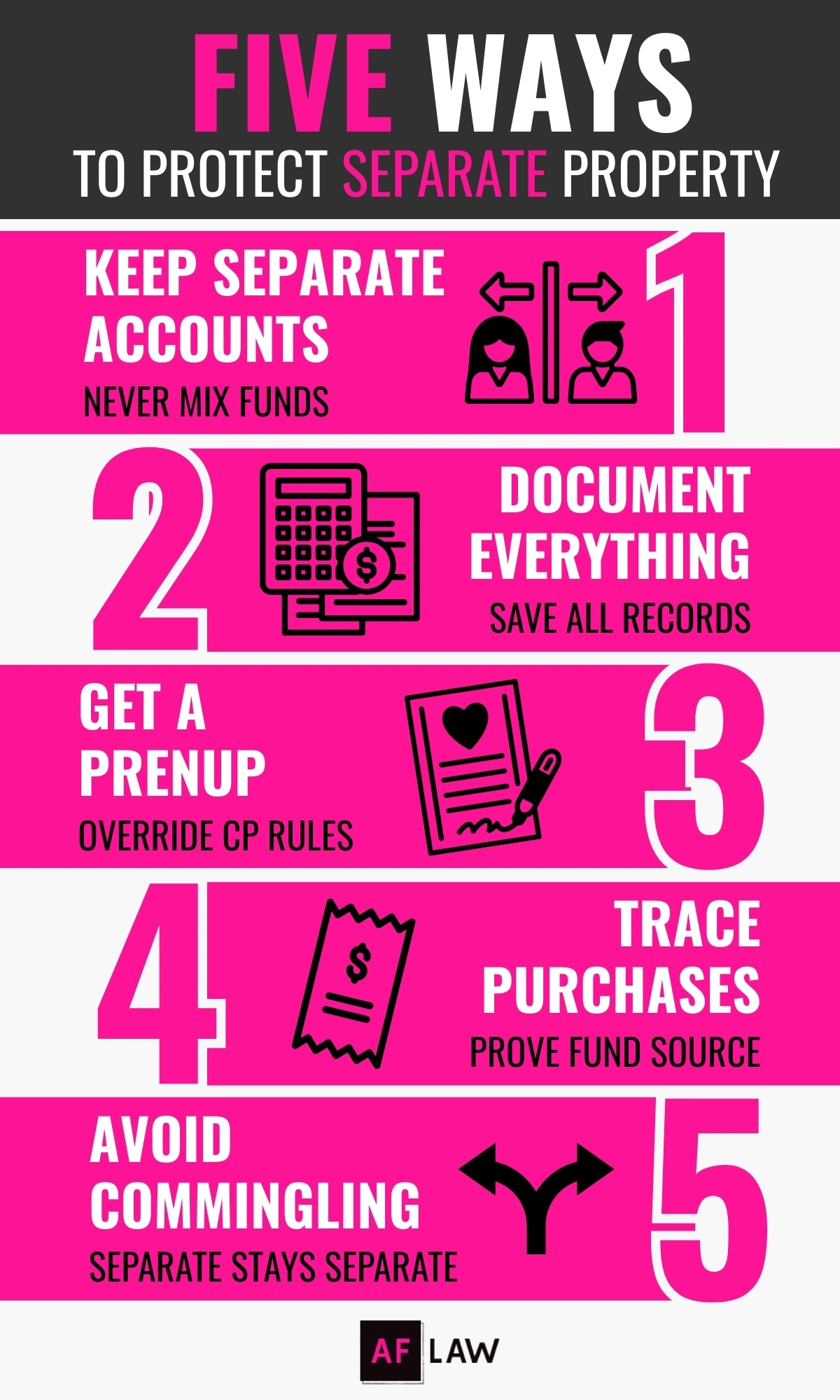
The best defense against community property disputes starts before problems arise, not during divorce proceedings. Proactive strategies like prenuptial agreements and strict account segregation can prevent the commingling and characterization battles that drive up legal costs.
Prenuptial Agreements
The terms of a prenuptial agreement can override many of California's community property presumptions. In your prenup, you can specify which assets will remain separate and how property will be divided if you ever divorce. Couples with significant wealth, business interests, or inheritance expectations tend to benefit most from prenups.
Postnuptial agreements serve a similar purpose for couples who didn't create prenups before marriage. Both require full financial disclosure and independent legal counsel to ensure they will be upheld.
Keeping Separate Funds Segregated
If you are concerned about commingling, never deposit funds from an inheritance, gifts, or pre-marital savings into joint accounts. Keep detailed records showing the source of all funds used for major purchases.
This includes financial documentation of any separate funds that you use for a down payment on a house. Courts presume that property purchased during marriage is community property unless you can prove otherwise with clear financial trails.
How Courts Value Assets for Division
California courts must value assets as close to the trial date as possible. Real estate, investment accounts, and business interests may fluctuate over weeks or months, which makes timing critical.
Date of Separation vs. Trial Date Valuation
For most assets, the value at the date of the divorce trial is the most important number.
Sometimes, however, the value at the date of separation is more relevant. If one spouse's post-separation efforts increased an asset's value, the court may consider the value of the asset at the time of separation. For example, if a business grew due to one spouse's work after the couple separated, the court will take that spouse’s solo efforts into account when dividing that asset.
This rule doesn’t apply to market-driven appreciation, such as real estate that increases in value due to housing market trends. In that case, the property value at the date of trial is more important since neither spouse personally caused the growth.
Key Protections and Rights in California

California courts enforce strict financial disclosure requirements during divorce. Both spouses must fill out legal forms with a comprehensive reporting of all known assets, debts, retirement accounts, and business interests. Judges can penalize spouses who hide assets or fail to disclose them fully.
The state updates these forms periodically in an effort to improve accessibility and prevent costly discovery disputes. Increasingly, courts prioritize financial transparency to streamline property division and reduce litigation expenses.
When You Need Legal Help with Property Division
Complex property issues require experienced family law attorneys. Forensic accountants and appraisers may be needed for cases involving business valuation, mixed-character real estate, or suspected hidden assets. This investment in protecting your assets may be well worth it.
Divorce mediation offers an alternative for couples who agree on basic facts but need help calculating exact divisions. Mediation costs less than full litigation, but it allows your attorney a chance to present evidence and advocate for your financial future.
Take Control of Your Financial Future
California's community property laws seem simple since they require marital assets to be split 50/50. The real battle involves proving what qualifies as community property and calculating accurate values. Without proper documentation and a clear legal strategy, you risk losing your assets to incorrect characterization.
The AF Law legal team has protected clients through complex property divisions, traced hidden assets, and calculated precise equity splits. We focus on getting the numbers right so that you can keep what's legally yours. Contact us today.

%205.avif)