When you get married in California, you are subject to the state's community property laws. If you haven’t agreed otherwise, any assets and debts either of you acquire during the marriage will be split equally should you divorce. Unfortunately, many couples discover too late that they should have set clearer financial boundaries before walking down the aisle.
As a Sacramento prenup attorney, I understand how challenging it is to establish those boundaries legally and fairly. I’ll explain California prenuptial agreement requirements, costs, and timelines, along with how to approach this conversation with your partner.
What Makes a Prenup Valid in California?
California follows the Uniform Premarital Agreement Act, which sets strict requirements for prenuptial agreements. Meeting the following criteria will help your agreement withstand scrutiny in California courts.
Written Agreement and Signatures
California law requires all prenuptial agreements to be documented in writing. They must be signed by both parties and notarized.
Full Financial Disclosure
Both prospective spouses must give a comprehensive accounting of all of their debts, income, financial accounts, property, and other assets before signing. Failure to provide full and accurate disclosure is one of the common reasons that California prenuptial agreements get invalidated.
Voluntary Execution
Both parties must sign the premarital agreement voluntarily, without coercion or duress. A prospective spouse who is presented with a prenup must be given the opportunity to seek legal counsel. It’s important to hire your own prenuptial attorney, whether you’re creating an agreement or reviewing one that your partner has presented to you.
The Critical 7-Day Rule
California's unique cooling-off period requires the spouses to be given at least seven days to review the final agreement before signing. Any changes to financial terms or spousal support provisions restart the clock. This rule is relatively new; it may not apply to older prenuptials.
Important note: Minor formatting changes may not restart the clock, but any significant modifications likely will.
It takes time to fully document each partner’s financial situation, draft the agreement, and make modifications if necessary. Couples should start working on a prenuptial agreement four to six months before their wedding date.
What Can and Cannot Be Included in a California Prenup
California law allows premarital agreements to address financial matters, but any terms that affect children or are illegal will not be valid. Knowing these boundaries helps you draft a legally binding agreement that California courts will enforce.
Allowed Provisions
Your California prenup can address several critical family law matters related to property and financial obligations.
Property Division
Prenuptial agreements allow couples to override the default 50/50 split set by California law. Couples can define which financial assets remain separate property versus community property. This protection may extend to premarital assets, inheritances, investment portfolios, and business interests accumulated before marriage.
Spousal Support Limitations
A spouse can waive or limit spousal support, but such provisions face strict scrutiny during legal separation or divorce proceedings. The party who waives support must have independent legal counsel in order for these spousal support provisions to be valid. California courts can deem the waiver unenforceable if it’s especially unfair, or “unconscionable.”
Debt Responsibility
Prenuptial agreements can protect one spouse from the other party's premarital debts or future financial obligations. This protection may be particularly important for business owners, those with student loan debt, or individuals with significant credit card debt accumulated before the relationship.
Prohibited Provisions
Certain terms violate California law and will be deemed unenforceable by family courts, regardless of voluntary consent from both parties.
Child Custody and Support
Any provisions attempting to predetermine child custody arrangements or limit child support obligations are unenforceable under California law. California courts always retain jurisdiction over family law matters affecting children's welfare, and no legal document can override this authority.
Illegal Requirements
Clauses that require illegal acts or that violate public policy will be struck down. A qualified attorney can identify language that might render your prenup agreement invalid.
Lifestyle Clauses
Non-financial clauses are generally unenforceable in California courts. For example, your prenuptial agreement cannot attempt to dictate the following:
- Restrict a spouse’s weight
- Mandate that a spouse maintain a specific appearance
- Require a spouse to be a stay-at-home parent
- Require a spouse to perform specific household chores or other tasks
These personal matters fall outside the scope of valid California prenups.
How Much Does a Prenup Cost in Sacramento?

Drafting a Sacramento prenup may cost between $1,500 and $10,000, although separate attorney fees may increase the total cost. Complex estates involving business interests or multiple properties tend to be more expensive, especially if the terms of the agreement must be negotiated.
The following factors may affect costs:
- The complexity of each spouse’s financial situation.
- The types of assets each spouse acquired before marriage and is expected to acquire in the future.
- Each attorney’s experience level and hourly rate.
- The length of the negotiation process.
- The need for forensic accountants or business valuators for high-net-worth individuals.
Although prenuptial agreements are more common between high-net-worth partners in California, every couple who intends to marry should consider one. The upfront legal cost may be well worth it since a prenup helps couples get on the same financial page and could prevent extensive court proceedings if a change in circumstances later causes the marriage to fall apart.
Understanding family law attorney costs helps couples budget appropriately. Spouses engaged in a contested divorce in California may spend between $17,000 and $26,300 each in legal fees. That’s significantly more than they would pay for a prenup.
When Should You Sign a Prenup?
Timing affects both legal validity and relationship dynamics. Proper planning prevents last-minute pressure that could make your premarital agreement vulnerable to challenges. Follow this general timeline:
- 6 to 12 months before the wedding: Begin conversations about marital expectations and financial transparency when emotions aren't heightened.
- 4 to 6 months before: Each prospective spouse should gather documents related to their finances and retain their own attorney to prevent a conflict of interest.
- 3 to 4 months before: An attorney will draft a California prenuptial agreement form based on each spouse’s financial disclosure and desired terms.
- 2 to 3 months before: Both parties review the draft with their independent counsel and negotiate any concerns.
- 1 to 2 months before: Both parties receive the final document and sign the written prenuptial agreement with their attorneys present.
Signing the agreement well in advance of your wedding allows for any last-minute concerns to be addressed and prevents you from running afoul of California’s seven-day waiting period. If you wait too long, a California court might deem the agreement involuntarily signed, particularly if one party felt pressured by the approaching wedding date.
Spousal Support Waivers: What You Need to Know

Alimony waivers are the most legally complex prenup provisions. They are subject to dual scrutiny, both at signing and during divorce proceedings. California courts examine these terms more carefully than any other aspect of premarital agreements.
Independent Counsel Requirement
Provisions that prevent one party from receiving spousal support are unenforceable unless the party who is waiving support had independent legal counsel at the time of signing. This means that both prospective spouses must retain separate attorneys. Shared counsel creates conflicts of interest that may invalidate the entire spousal support section.
The "Unconscionability at Enforcement" Standard
Even waivers that initially satisfy California’s prenuptial requirements can be challenged years later if a judge deems them unconscionable during legal separation or divorce proceedings. California courts consider changed circumstances, such as job loss, health issues, or childcare responsibilities, that disadvantage one party significantly.
Exceptions for Temporary Support
A spousal support waiver does not take effect automatically upon separation. According to recent case law, a court can order temporary spousal support to be paid while the validity of the prenup is being litigated. The court can do this if it deems a spouse financially vulnerable, even if the prenuptial agreement seems to have a clear and legal waiver.
Strategic Alternatives
Some couples limit rather than completely waive spousal support, setting caps on the amount or the duration based on marriage length. This approach creates a balanced outcome that California courts are more likely to approve. A qualified attorney can structure provisions that protect both parties while remaining legally enforceable.
Important note: Structure support provisions with step-up clauses or conditional limits to make your agreement more likely to withstand judicial scrutiny and reduce the risk that a judge will deem it unconscionable.
Common Mistakes That Invalidate Prenups

Even well-intentioned agreements fail when couples overlook California's technical requirements. Avoiding these errors protects your financial interests:
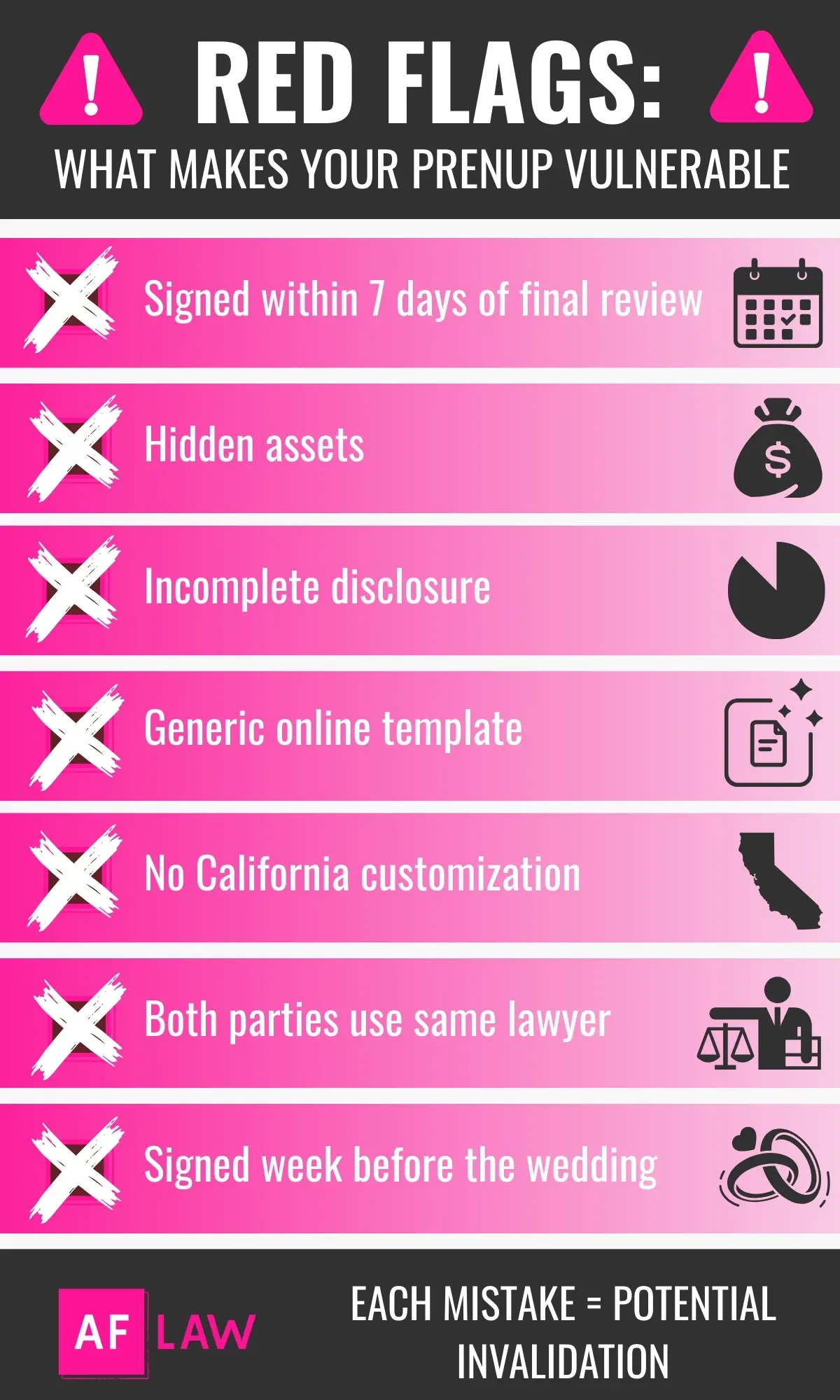
- Last-minute signing: Written prenuptial agreements signed within 7 days of the wedding face automatic invalidation challenges.
- Incomplete financial disclosure: Omitting financial assets, even unintentionally, gives the other party grounds to void the entire agreement.
- Using generic templates: Online prenuptial agreement forms that don't account for California's unique community property laws may fail in the courts.
- No independent attorneys: Both parties need separate legal representation, particularly for spousal support provisions, which California courts scrutinize heavily.
- Ignoring future inheritances: While inheritances are separate property by default, prenups should clarify management during marriage and prevent commingling issues.
Download our free California prenuptial agreement form as a starting point. This template is for educational purposes only and should not replace consultation with an independent attorney who understands California law.
How to Talk to Your Partner About a Prenup
The conversation about a prenup may feel more difficult than the legal process. Approaching it with empathy will strengthen both your relationship and your financial future.
Around 25% of couples say that money issues are the biggest challenge they face, and conflicts around finances are a common cause of divorce. This makes prenuptial financial planning a practical necessity rather than a sign of distrust.
Frame the discussion in a way that establishes financial transparency and expectations from the start. Consider these effective approaches:
- Start the conversation soon after your engagement, before the stress of wedding planning complicates things.
- Focus on mutual protection and financial transparency rather than potential divorce scenarios.
- Keep California’s community property laws and the state’s default 50/50 split of marital assets in mind.
- Consider scheduling a few sessions with a couples counselor if the topic creates tension.
- Share that 15% of married Americans have prenuptial agreements and that 33% of unmarried adults expect to sign one in the future.
Many couples find that the full disclosure process required by California law actually brings them closer together by forcing honest conversations about financial obligations, debts, and future financial goals.
Secure Your Financial Future: Work with an Experienced Sacramento Prenup Attorney
California prenups require strict adherence to rules concerning financial disclosure, the state’s seven-day waiting period, and independent legal counsel, particularly for spousal support waivers that face extra scrutiny. Starting the process four to six months before your wedding date allows enough time to agree on terms that make your agreement legally enforceable.
At AF Law, my team and I provide direct, strategic guidance for Sacramento couples navigating California prenuptial agreement requirements. Contact us today to schedule a consultation and establish clear financial boundaries before your marriage begins.

%205.avif)