Marriage combines your and your spouse’s financial lives in ways most couples never discuss before the wedding. California's community property laws mean all property and assets earned during marriage get split 50/50 in divorce, regardless of who earned them.
As a Sacramento prenup attorney with over 14 years of California family law experience, I've guided countless couples through the complexities of creating enforceable prenuptial agreements. This guide lays out the exact process of creating a prenuptial agreement in California, from the initial conversation to the final execution.
What Is a Prenuptial Agreement?

A prenuptial agreement is a written contract drawn up between two people prior to marriage that determines how assets, debts, and financial matters will be handled during the marriage and in the event of divorce. This legal document overrides California's default community property rules, allowing couples to control their financial arrangements.
The Core Function of Prenups
California is one of nine community property states where marriage automatically creates an even split of all assets acquired during marriage. A prenup allows couples to designate future income or assets as separate property, protecting what each spouse brings into the marriage and what they earn during it.
Without a prenup, California's rigid default regulations apply, meaning your house, your business growth, and your retirement contributions all get divided equally, regardless of who earned them.
Common Misconceptions About Prenuptial Agreements in California
Many engaged couples hesitate when the topic of prenuptial agreements comes up, often due to outdated beliefs about what these contracts represent. Here are some common misconceptions regarding prenups:
Prenups Signal Mistrust or Planning for Divorce
Forward-thinking couples view prenuptial agreements as financial planning tools that create security. These arrangements can effectively function as "marriage plans," establishing clear expectations for finances during the marriage.
Only Wealthy People Need Prenups
Middle-income earners benefit substantially from prenups, as California's 50/50 split can force the sale of primary residences and retirement accounts. Protecting modest but meaningful assets often matters more than protecting millions.
Prenups Are Unromantic
Financial transparency strengthens marriages. Disagreements about money contribute to around 38% of divorces, making clear expectations and communication vital for long-term marital success.
What Can You Include in a California Prenup?
California's Uniform Premarital Agreement Act (UPAA) governs what couples can legally address in prenuptial agreements, with specific permitted and prohibited subjects. Understanding these boundaries can save you valuable time by preventing you from drafting unenforceable provisions.
Assets and Property Rights
First, prenuptial agreements in California can dictate the division of shared assets, separately owned property, real estate, investments, and inheritance rights.
This can be particularly important for spouses in blended families who want to protect the inheritances of children from previous marriages. A prenup can ensure that specific assets pass to your kids rather than becoming community property subject to division.
Debt Allocation and Financial Responsibilities
Prenups can also address who pays existing debts, such as student loans, and how future debts are to be handled during the marriage. This prevents one spouse from being held liable for the other's financial obligations, which could be critical if your partner carries significant credit card debt or business loans.
Business and Intellectual Property Protection
For Sacramento's entrepreneurs and tech professionals, prenups protect business interests and intellectual property from becoming marital assets. These clauses prevent forced business sales or 50/50 divisions that could disrupt operations or require you to liquidate your company to pay your ex-spouse.
Similarly, protection for unvested stock options and equity compensation common in California employment can ensure that your RSUs and ISOs remain separate property.
Spousal Support Terms (with Limitations)
California courts scrutinize alimony provisions more than any other clause. Unlike property division, spousal support provisions must remain fair at the time of divorce, and California courts can review them for unconscionability regardless of what you agreed to years earlier.
Waivers are more likely to be upheld when both parties had independent legal counsel and individual earning capacity at the time of signing.
What Can’t a Prenup Include?
California law strictly prohibits certain provisions in prenuptial agreements, and including them can invalidate your entire contract. Notable examples include:
Child Custody and Visitation
In California, prenups cannot affect custody arrangements. These decisions must be made at the time of divorce based on the child's best interests, which can’t be predetermined.
Child Support Obligations
Courts decide child support using state guidelines that reflect each parent's income and the child's needs. Any prenup clause that attempts to limit or waive child support is unenforceable and against public policy.
Knowing what to include in your prenup is only the first step. The state has strict legal requirements for how prenups must be created in order to be valid.
California's Legal Requirements for Valid Prenups

California has some of the nation's strictest prenup requirements, established to keep prenuptial agreements from being used to pressure vulnerable partners. These rules are intended to protect both parties from coercion and ensure voluntary consent.
Mandatory Seven-Day Waiting Period
California Family Code § 1615 requires at least seven calendar days between when the final agreement is presented and when it's signed. This serves to prevent last-minute pressure before weddings when the engaged parties have already paid deposits and sent invitations.
It’s important to note that rushing the prenup process or signing under pressure is a primary ground for invalidation in court challenges.
Independent Legal Counsel
Each party must have its own attorney or formally waive representation in a separate written document after being advised to seek independent legal counsel. Both parties should work with certified specialists in family law.
Complete Financial Disclosure
Both parties must provide full, honest disclosure of all assets, debts, income, and other financial obligations. California's Digital Financial Assets Law gives the courts the authority to require the disclosure of cryptocurrency, NFTs, and other digital holdings.
These aren't just suggestions — they're hard and fast legal requirements. Failing to satisfy any one of these three elements makes the entire agreement vulnerable to court challenges.
Getting a Prenup in California: Step-by-Step Process
The prenuptial agreement process follows a specific timeline dictated by California's seven-day rule, which calls for strategic planning and early initiation. Missing key deadlines or trying to hurry things along could provide grounds for your future spouse to challenge the agreement.
Step 1: Start the Conversation Early
Openly discuss finances with your future spouse three to six months before the wedding (not weeks before). Identify what assets each person wants to protect and what concerns each has about debt or future earnings. Begin researching Sacramento prenup attorneys who focus on family law and have experience drafting compliant agreements.
Step 2: Gather Complete Financial Documentation
Round up statements for all bank accounts, investment portfolios, retirement accounts, real estate deeds, business valuations, debt statements, and tax returns from the past two to three years. For tech workers, include details on stock options and equity compensation vesting schedules, since these often represent significant assets that need protection.
Step 3: Retain Independent Counsel
Both parties should hire separate attorneys to represent their individual interests throughout the negotiation. Never share a lawyer, as doing so violates California law and guarantees that the prenup will be invalid if challenged.
Your Sacramento prenup attorney will review your financial situation and draft terms that protect your interests while ensuring that the agreement remains legally enforceable.
Step 4: Draft, Negotiate, and Finalize
The attorneys will exchange drafts and negotiate terms on behalf of you and your future spouse, potentially revising the language multiple times. This phase can take several weeks, depending on complexity and how far apart your initial positions are. The goal is to reach an agreement that both parties understand and accept voluntarily without pressure.
Step 5: Wait Seven Days, Then Sign
Once the final version is ready, California law requires that the parties wait at least seven full calendar days before signing. Both parties must sign voluntarily, with no pressure or duress, which means no signing the morning of your wedding or during the week before, when stress is highest. The signed agreement must be notarized to be enforceable.
How long does a California prenup last? Once finalized, a California prenup has no expiration date. It will remain in effect throughout the marriage and be used to govern divorce proceedings regardless of when divorce occurs, whether it’s two years or 20 years later.
How Much Does a Prenup Cost in Sacramento?
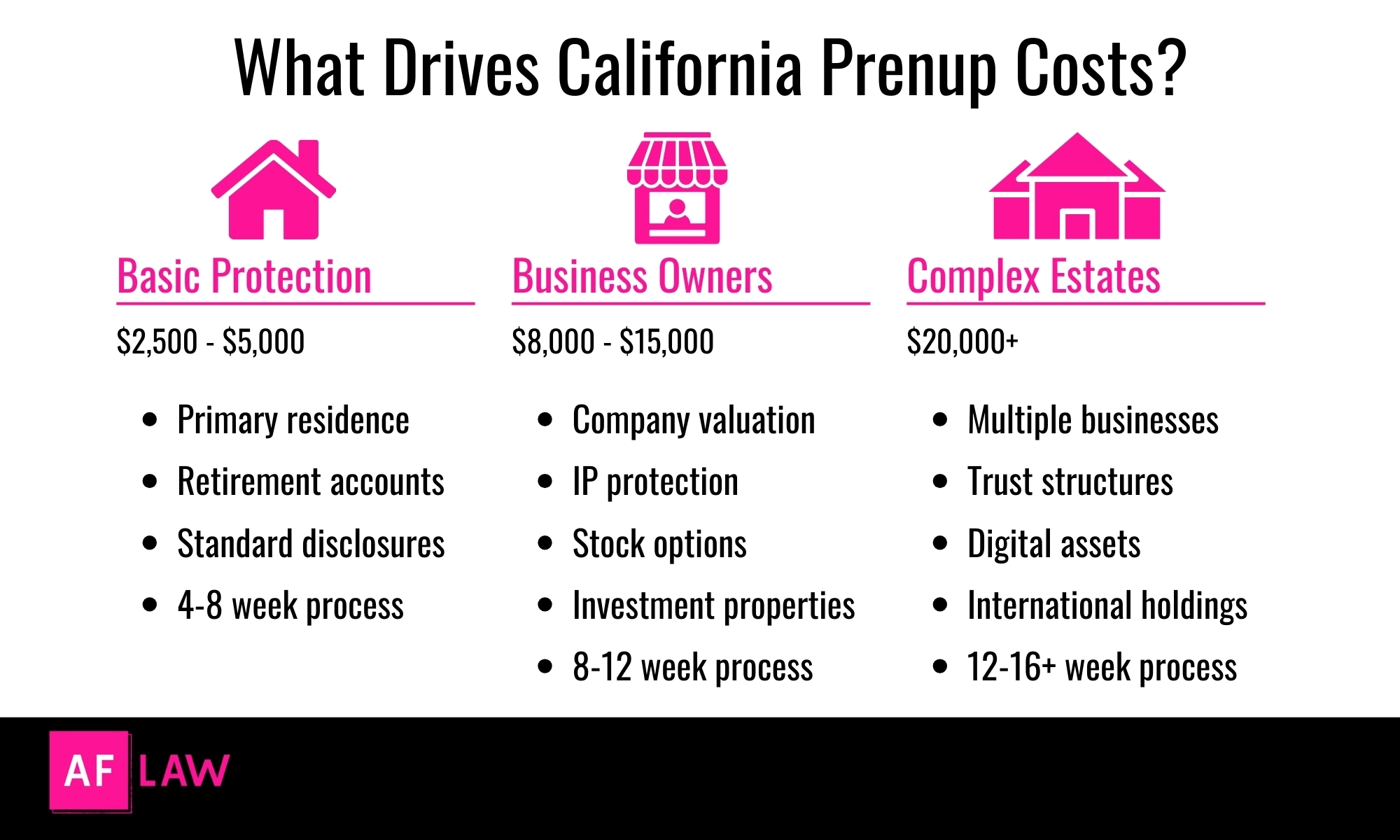
The cost of getting a prenuptial agreement can vary widely based on financial complexity and the duration of negotiations, with California prenups costing more than the national average due to the state's strict procedural requirements. Understanding the potential costs involved can help you budget appropriately and avoid cutting corners:
Why Prenups Cost More in California Than in Other States
California's mandatory independent counsel requirement means paying two attorneys instead of one, immediately doubling the legal fees compared to states without this mandate. The state’s seven-day waiting period and financial disclosure requirements also add billable hours for document preparation, review, and verification.
Moreover, complex community property laws require particular guidance, and certified family law specialists charge higher rates reflecting their advanced credentials and deeper knowledge of California prenups.
Viewing Cost as Legal Insurance
A low-cost, rushed prenup that fails the procedural requirements will become worthless when challenged in court. The upfront investment for proper drafting and legal representation is substantially less than contested divorce litigation over business valuation and asset division, which can easily exceed $50,000.
It’s therefore worth the premium to ensure enforceability when you need it most, as cutting corners on legal fees only creates greater long-term financial risk.
Can You Write Your Own Prenuptial Agreement?
Technically yes, but it's inadvisable and likely unenforceable. California courts rarely uphold self-drafted prenups because they typically fail to meet mandatory disclosure requirements, lack proper legal language, and don't comply with the independent legal counsel mandate.
Common Mistakes That Invalidate California Prenups
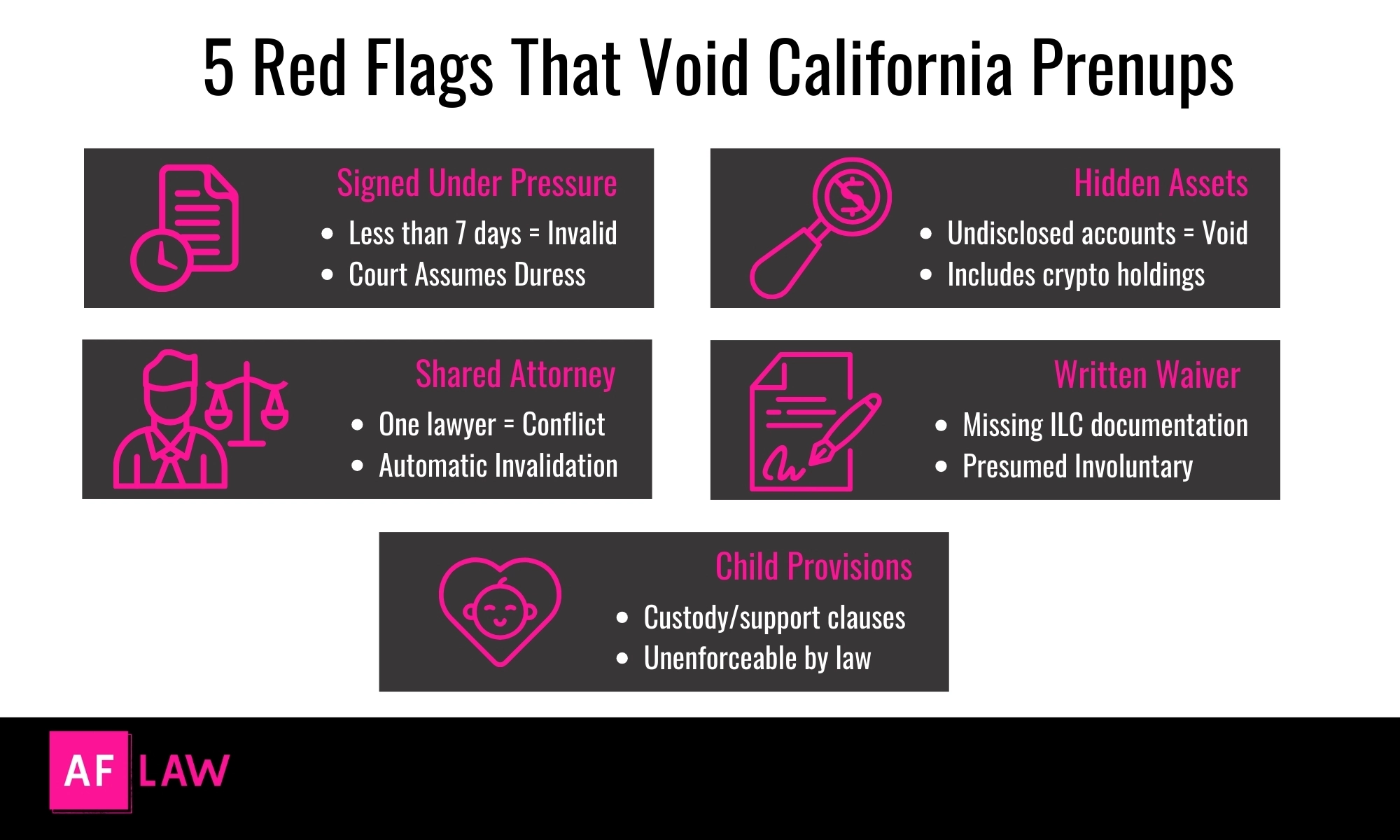
Most invalidated prenups fail due to procedural errors, not unfair terms. It’s critical to be aware of the following pitfalls to avoid costly mistakes that may surface years later during divorce proceedings:
Signing Too Close to the Wedding Date
Courts generally view last-minute signing as evidence of coercion or duress. If a prenuptial agreement is presented days before a wedding, with deposits paid and guests traveling from out of town, the pressured party may feel like they can’t say no without jeopardizing the entire wedding. The seven-day rule exists to prevent this scenario and promote voluntary consent.
Failing to Disclose All Assets
Hiding bank accounts, cryptocurrency holdings, or business interests automatically provides grounds for invalidation. As such, full transparency is non-negotiable, even for assets you consider separate or minor. Courts don't distinguish between accidental omissions and intentional concealment.
Using a Single Attorney or Online Template
Shared legal representation creates an immediate conflict of interest and violates California law. And generic online templates may lack state-specific provisions and fail to address the mandatory disclosure and waiting period requirements. These shortcuts can create vulnerabilities that surface during divorce when the stakes are highest.
Ensuring procedural compliance demands professional legal guidance from an experienced attorney who knows California prenups.
Take Control of Your Financial Future Before Marriage

Getting a prenup in California requires careful advance planning, mandatory independent legal counsel for both parties, complete financial disclosure (including digital assets), and strict adherence to the seven-day waiting period. These criteria protect both spouses by ensuring voluntary, informed decision-making about important financial arrangements.
AF Law provides strategic guidance for prenuptial agreements in Sacramento, Yolo, and Placer counties. With over 14 years of family law experience, I can make sure your prenup meets all legal requirements while safeguarding your financial interests.
Contact our team today to schedule your consultation and take steps to secure what you’ve worked so hard to build.

%205.avif)