When a divorce begins, the family home often becomes the subject of intense disagreement. Questions about who stays, who leaves, what’s fair, and who gets the equity are abundant. California's community property rules make this fight predictable, but that doesn't make it simple.
As a Sacramento property division attorney, I handle house division cases that involve hundreds of thousands of dollars in equity. The stakes are high, and the rules are specific. This guide explains exactly how California courts determine who gets the house in a divorce, what factors matter, and how to protect your share.
California's 50/50 Rule: What It Really Means
California operates under community property law, which means marital property is split equally. The house isn't exempt from this rule, but an equal share doesn't always mean you sell and split the proceeds.
Community Property vs. Separate Property
Timing, source, and characterization all factor into how California courts classify marital property. Property acquired during marriage is generally community property, owned equally by both spouses regardless of whose name appears on the title.
Separate property typically includes assets owned before marriage, gifts received by one party, and inheritances. Importantly, property purchased using separate property funds generally retains its separate character, provided that the source of funds can be properly traced and documented.
California Family Code Section 760 establishes this presumption of community property for assets acquired during marriage.
When Separate and Community Property Mix
Houses frequently combine both property types. One spouse owns the house before marriage, then both spouses make mortgage payments using marital income. The original value remains separate property, but equity built through community funds becomes community property.
Consider this scenario: You bought a house for $400,000 before marriage with a $320,000 mortgage. During your ten-year marriage, you paid down $100,000 of principal using marital income. The house, now worth $700,000, contains both separate and community interests. Your separate property includes the $80,000 initial equity. The community owns the $100,000 in principal payments plus proportional appreciation.
Family Code 2640 Reimbursement
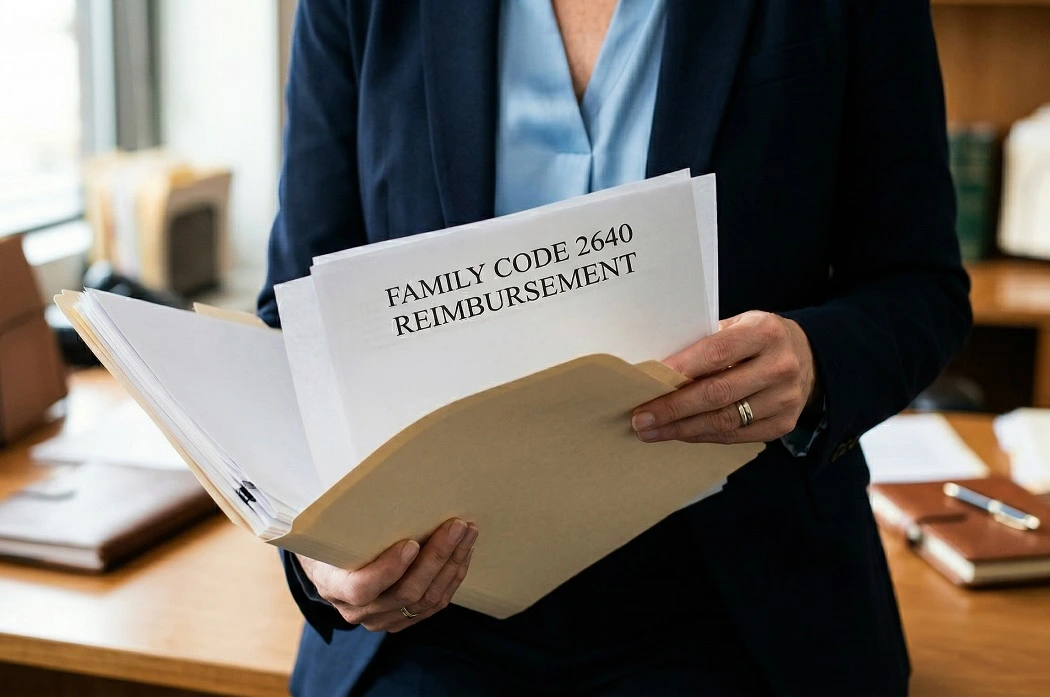
California law protects separate property contributions through Family Code Section 2640. This statute entitles you to dollar-for-dollar reimbursement when you use separate funds for certain expenses.
What Qualifies for Reimbursement?
Reimbursement covers down payments from separate funds, property improvement payments, and principal reductions. The law excludes interest payments, maintenance costs, insurance, and property taxes.
If you inherited $50,000 and used it as a down payment on your marital home, you can claim that $50,000 as a credit during property division. The reimbursement doesn't include appreciation or interest, just the dollar amount contributed. The claim cannot exceed the property's net value at division time.
Proving Your Separate Property Claim
Documentation is crucial for success. Courts need clear evidence showing the source of funds for property acquisition, such as escrow documents, bank statements, and proof of inheritance or pre-marital savings.
Without this, courts may treat your separate contribution as a gift to the community, thereby forfeiting your reimbursement rights. Additionally, a signed written agreement can preclude reimbursement claims.
Five Ways to Divide the House
California courts and divorcing couples use several methods to handle the family home. Each option carries different financial and practical implications.
1. Selling and Splitting Proceeds
The cleanest solution is to sell the house and divide the net proceeds equally. This works when neither party can afford to buy out the other spouse or when the parties need immediate liquidity. Selling costs include realtor fees (typically 3% to 6% of the sale price), the outstanding mortgage balance, property tax adjustments, and any repair costs the buyer may require.
2. Buyout Through Equalization Payment
One party retains the house and pays the other party their 50% share of the community interest. The buyer may refinance to cash out equity, use other assets to offset the home's equity, or trade the house for retirement assets.
Refinancing requires sufficient income, an acceptable credit rating, and adequate home equity. Lenders scrutinize these factors during divorce proceedings.
3. Deferred Sale of Residence
Courts sometimes delay the sale when minor children benefit from staying in the family home. The custodial parent typically remains in the house until the youngest child turns 18 or graduates from high school. Both parties retain ownership interest during this period.
This arrangement requires clear written agreements about mortgage payments, property maintenance, insurance, and early sale provisions. Child custody arrangements often influence these decisions.
4. Co-Ownership After Divorce
Some divorcing couples maintain joint ownership, particularly when market conditions make an immediate sale unfavorable or when the property generates rental income. This requires strong communication, detailed written agreements, and shared financial responsibility.
5. Court-Ordered Partition Sale
When parties cannot agree, courts order the sale of the property and the division of the proceeds. This eliminates ongoing disputes but removes control over timing, sale price negotiation, and buyer selection.
Which Factors Actually Matter to Judges
When courts decide house division disputes, several factors influence the final order beyond the basic 50/50 rule. These considerations determine whether one spouse can stay or if the house must be sold.
Custody and Children's Stability

Courts prioritize children's welfare. The parent with primary child custody often receives favorable consideration for remaining in the family home, particularly when changing schools would disrupt the children's education or when the home is close to extended family support networks.
Economic Feasibility
Can you afford the house alone? Courts examine income and employment stability, ability to qualify for refinancing, and capacity to maintain the property. Keeping the house shouldn't leave you house-rich but cash-poor.
Competing Interests
Multiple assets require strategic division. Trading the house for retirement benefits might make sense when one party has substantial pension accounts or business interests. Courts aim for an overall equitable division, not necessarily an equal division of each asset.
Domestic Violence Considerations

Domestic violence history can influence housing decisions. Courts may award the house to the protected party, order the abusive party to leave immediately, or include housing provisions in restraining orders.
Length of Marriage
Longer marriages typically mean a greater share of community property. A 20-year marriage in which one spouse owned the house before the marriage results in substantial community interest through mortgage payments and appreciation.
Title Insurance Company Complications
The mortgage and title transfer create technical obstacles that can delay division. When transferring house ownership during divorce:
- Title insurance companies scrutinize divorce transfers: They require proof that the transfer complies with your divorce decree through a quitclaim deed or interspousal transfer documentation.
- Due-on-sale clauses threaten immediate payment demands: Most mortgages allow lenders to demand full payment when ownership changes, though lenders rarely enforce this for divorce transfers.
- Failing to refinance leaves both parties liable: The departing spouse remains on the loan despite losing ownership, risking credit damage if the remaining party defaults.
Lenders can pursue both parties for deficiency balances when one party remains on the mortgage after the ownership transfer. This makes refinancing essential, not optional. The spouse keeping the house refinances it in their name alone, removing the other party from loan liability and title concerns.
Common House Division Scenarios
These hypothetical divorce cases can reveal how California's rules play out in practice.
One Spouse Owned a Home Before Marriage
You bought a $300,000 house before marriage with a $240,000 mortgage. During your 12-year marriage, community funds paid down $120,000 in principal. The house, now worth $600,000, contains separate property (original $60,000 equity plus proportional appreciation) and community property (the $120,000 in payments plus proportional appreciation).
Inheritance Was Used for a Down Payment
Your spouse inherited $80,000 and used it as the down payment on your $400,000 marital home. Under Family Code 2640, that $80,000 gets reimbursed dollar-for-dollar before splitting the remaining equity, assuming proper documentation exists and no written waiver was signed.
Both Names Are on the Title, One Spouse Pays
The title doesn't determine ownership in California. Even if only one spouse earned income that paid the mortgage, community property rules apply. The earning spouse doesn't get extra credit for making payments with their paycheck because that income belongs to the community.
House Purchased During Marriage Is Now Underwater
When the mortgage exceeds the home's value, you're splitting debt, not equity. Courts assign the negative equity equally unless one party agrees to assume it in exchange for other considerations in the divorce settlement.
Common House Division Mistakes That Cost You
Without the right team to back you up, it’s easy to make mistakes that derail settlements and drain equity.
Assuming Equal Means Fair
California requires equal division of community property, but equal doesn't always mean each asset splits 50/50. You might take 100% of the house while your spouse takes 100% of the joint retirement accounts, achieving overall equal division through offsetting assets.
Ignoring Tax Consequences
Capital gains exclusion allows up to $250,000 for single filers and $500,000 for married couples filing jointly. The timing of the sale significantly affects tax liability. Spousal support payments also create tax considerations in property division.
Forgetting Refinancing Requirements
Wanting the house doesn't mean you can keep it. Lenders require stable income, acceptable credit, and sufficient equity. Start the refinancing process early to avoid last-minute surprises.
Skipping Professional Valuations
Zillow estimates aren't appraisals. Professional appraisers provide detailed analyses considering comparable sales, property condition, neighborhood trends, and market timing. This defensible valuation prevents disputes.
Misunderstanding Reimbursement Claims
Not all separate property contributions qualify. Interest payments and maintenance costs don't count, and you need documentation proving a separate source. Don't assume the house is "yours" because you made the down payment without proper evidence.
When You Can't Agree: Litigation Strategy

Sometimes, coming to an agreement isn’t feasible, but that’s not the end of the line. Contested house division moves to trial when settlement fails.
I have extensive experience defending my clients in court and can vigorously argue for a fair division in your case. I present evidence through:
- Property character documentation: Establishing whether the house is community property, separate property, or commingled through purchase documents and payment records.
- Separate property contribution proof: Tracing down payments and improvements to separate sources through bank statements and escrow files.
- Valuation challenges: Presenting professional appraisals that counter inflated or deflated valuations proposed by your spouse.
- Custody and economic feasibility arguments: Demonstrating why you should receive the house based on the children's stability and financial capability.
- Expert witness testimony: Appraisers provide market valuations, forensic accountants trace separate contributions, and financial planners analyze long-term affordability.
Communicate your preferences well in advance because trial preparation determines whether you keep the house or receive fair compensation for your community interest. The judge's decision becomes final unless appealed.
Your Next Move: Protect Your Home Equity
California's community property system creates predictable outcomes, but house division involves complex financial calculations, strategic positioning, and thorough documentation. Whether you want to keep the house or secure a fair share of your community interest, early action protects your rights.
As a leading Sacramento family law firm, we analyze your property's characteristics, calculate accurate community interests, identify reimbursement claims, and develop division strategies that protect your financial future. Our approach ensures that you remain informed and empowered throughout the process. Schedule a consultation today to discuss your situation and get advanced guidance.

%205.avif)